
The quick answer
- Pro Breeze compressor dehumidifiers cost about 3.9p–18.8p an hour at full power, at 26.32p per kWh (the Ofgem price cap from 1 October 2026). Most home-sized models, 6L to 20L, cost just 3.9p–8.7p.
- The OmniDry 20L costs about 8.7p an hour: 69p for 8 hours, or about £20.85 for 30 eight-hour days.
- Real costs are usually lower: with a humidistat, the dehumidifier switches itself off once the room reaches your target humidity.
- Best value per litre in the OmniDry range: the OmniDry 40L, at about 17% less per litre than the OmniDry 12L (8.7p vs 10.5p).
- See the running cost of all 15 models.

How much does a dehumidifier cost to run? Less than most people expect. A modern low-energy dehumidifier can use about the same power as a few old-style light bulbs, yet it can pull 10, 20 or even 40 litres of water out of your home's air every day. That means drier rooms, faster-drying washing, fewer musty smells and less condensation on the windows, for a few pence an hour. Here are the UK running costs for 15 Pro Breeze dehumidifiers, worked out from each model's rated power at the current price cap.
1Dehumidifier running costs by model (UK)
All figures assume the dehumidifier runs flat out at its rated power, taken from Pro Breeze product specifications (the rating label, at 27°C/60% RH where stated). Monthly figures assume 8 hours a day for 30 days. The last column is the cost per litre at maximum extraction: kW × 26.32p × 24 hours ÷ litres per day.
| Model | Power | Per hour | Per 8 hours | Per month (8 h/day) | Cost per litre removed |
|---|---|---|---|---|---|
| 1500ml Mini | 40 W | 1.1p | 8p | £2.53 | 50.5p |
| 6L Compact | 149 W | 3.9p | 31p | £9.41 | 15.7p |
| OmniDry 10L | 160 W | 4.2p | 34p | £10.11 | 10.1p |
| OmniDry 12L | 200 W | 5.3p | 42p | £12.63 | 10.5p |
| 12L Compact | 184 W | 4.8p | 39p | £11.62 | 9.7p |
| 12L with Humidistat | 200 W | 5.3p | 42p | £12.63 | 10.5p |
| OmniDry 20L | 330 W | 8.7p | 69p | £20.85 | 10.4p |
| 20L Premium Laundry Mode | 270 W | 7.1p | 57p | £17.06 | 8.5p |
| 20L Max Extraction | 320 W | 8.4p | 67p | £20.21 | 10.1p |
| AeraDry™ 25L 2-in-1 | 370 W | 9.7p | 78p | £23.37 | 9.3p |
| 30L Smart | 715 W | 18.8p | £1.51 | £45.17 | 15.1p |
| 30L Max Extraction | 600 W | 15.8p | £1.26 | £37.90 | 12.6p |
| OmniDry 40L | 550 W | 14.5p | £1.16 | £34.74 | 8.7p |
| 50L Industrial | 630 W | 16.6p | £1.33 | £39.80 | 8.0p |
| 10L Desiccant | 620 W | 16.3p | £1.31 | £39.16 | 39.2p |
Full-power figures at 26.32p per kWh, the Ofgem price cap electricity unit rate for Direct Debit customers from 1 October 2026 (average across Great Britain). Standing charge excluded. Rated power and maximum extraction rates from Pro Breeze product specifications; the 50L Industrial is rated at 50 L a day at 30°C/80% RH.
2How to work out your own cost
Every dehumidifier lists its power on the product page and the rating label. To work out the cost:
For example, the OmniDry 20L uses 330 W, which is 0.33 kW. Running it for 6 hours at 26.32p per kWh: 0.33 × 6 × 26.32 = about 52p. Your electricity bill shows your own unit rate.
3Why your real cost is usually lower
The table shows worst-case, full-power figures. In everyday use most homes pay less, because a good low-energy dehumidifier doesn't run flat out all day:
- Humidistat control: set a target such as 50% and the compressor rests once the room gets there, then starts again only when humidity rises.
- Laundry mode is the exception: it runs continuously at close to full power and ignores your humidity target until the timer ends or the tank is full. Set the timer to match your drying time, so you only pay for the hours you need.
- Timers and smart apps: on our smart models you can schedule it from your phone, so it only runs when it's needed.
- Drier homes need less work: once the damp is under control, the dehumidifier spends more time idling than extracting.

4Compressor vs desiccant vs mini: which is cheapest to run?
| Mini (Peltier) | Compressor | Desiccant | |
|---|---|---|---|
| Example | 1500ml Mini, 40 W | OmniDry 12L, 200 W | 10L Desiccant, 620 W |
| Cost per hour | 1.1p | 5.3p | 16.3p |
| Water removed per day (max) | 0.5 L | 12 L | 10 L |
| Cost per litre | 50.5p | 10.5p | 39.2p |
| Best for | Wardrobes, small bedrooms | Heated homes, laundry, condensation | Cold rooms, garages, conservatories |
Compressor dehumidifiers are the cheapest way to remove a lot of water in a normally heated home. Mini dehumidifiers cost pennies a day, but they remove much less water, so they suit small spaces. Desiccant dehumidifiers use more power, but they keep working in cold spaces where a compressor model slows down: our 10L Desiccant is rated to work from 1°C. If your dehumidifier lives in a garage or unheated room, see our guide to the best dehumidifier for cold rooms and garages.
5Dehumidifier vs tumble dryer: cost comparison
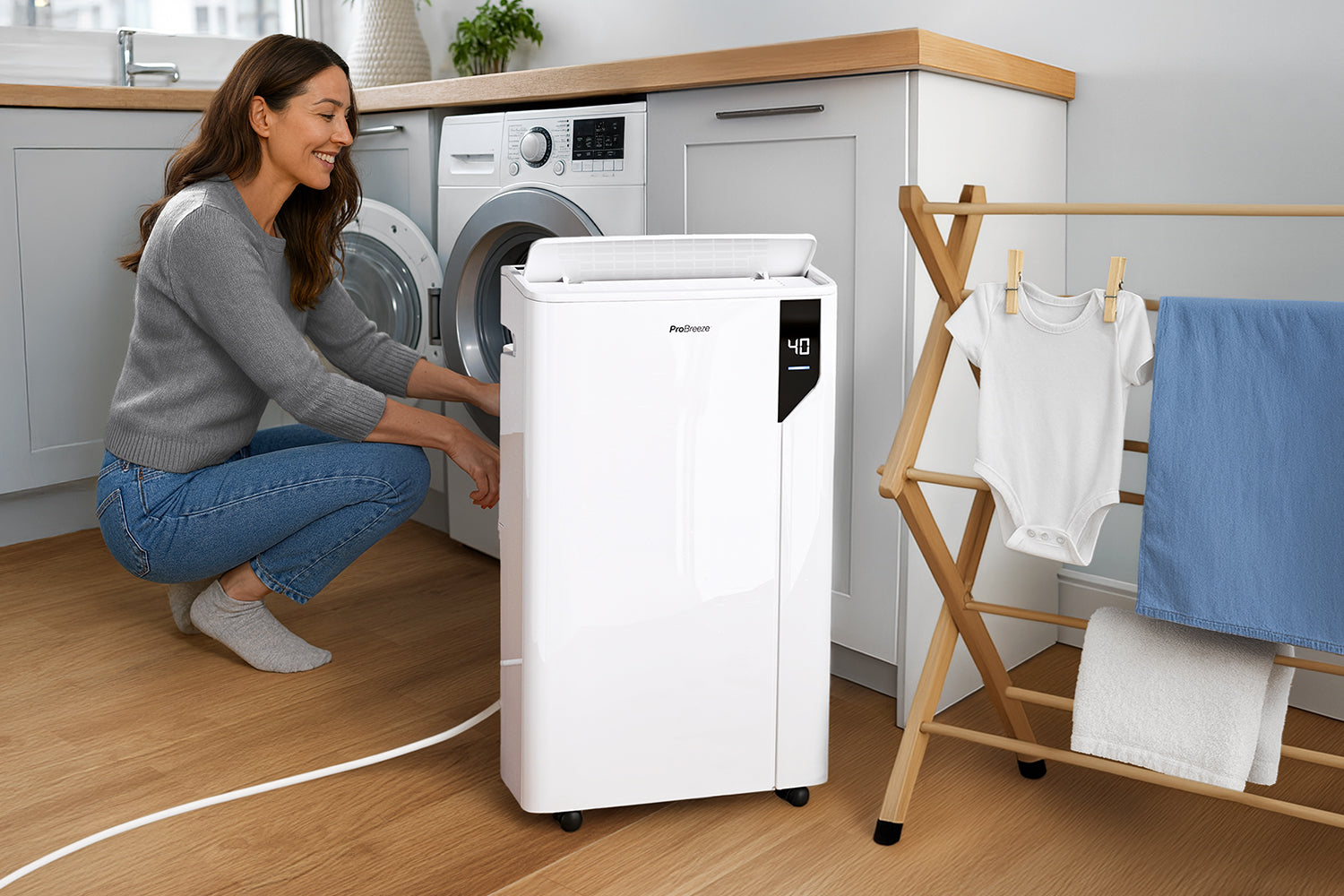
Which? puts a load in a condenser tumble dryer at about 89p and a vented dryer at about 90p. Drying a load on an airer with the OmniDry 20L running for 6 hours costs about 52p at full power, around 40% less than a condenser or vented dryer (and the OmniDry 12L does the same 6 hours for about 32p, under half), and the dehumidifier is drying the room at the same time, cutting condensation and damp. A tumble dryer does nothing for the damp in your home. Drying with the heating on and the windows shut is the costly way: it puts all that moisture back into your walls. Read our full guide on how to dry clothes indoors with a dehumidifier.
6How long should a dehumidifier run each day?
- Everyday humidity control: leave it on humidistat mode at around 50% and let it decide. In a well-controlled home it may only run a few hours a day.
- Drying washing: until the clothes are dry, with laundry mode, the door shut and the airer close to the machine. Set the timer, because laundry mode keeps running until the timer ends or the tank is full.
- Tackling condensation or damp: run it longer at first, especially overnight in bedrooms, then reduce once windows stay dry in the morning.
- After a leak or flood: continuous running, ideally with continuous drainage, until the room is dry.
For help with wet windows and black spots, see our guide to using a dehumidifier for condensation and mould.
76 ways to cut dehumidifier running costs
- Use the humidistat. 50% is a good target for most rooms. Going lower costs more for little benefit.
- Shut the door. A dehumidifier dries the room it's in. Leaving the door open means drying the whole house.
- Pick the right size. An undersized machine runs flat out for hours. Our 13-step dehumidifier buying guide helps you choose.
- Clean the filter. A clogged filter makes the machine work harder.
- Run it on cheaper electricity. If you have a time-of-use tariff, schedule it overnight with a timer or the smart app.
- Give it space. Keep it away from walls and curtains so air flows freely.
8Our OmniDry range: low running costs

OmniDry 10L
Just 160 W, about 4.2p an hour. Compact and space-saving at 38 dB, with laundry mode.
View OmniDry 10L
OmniDry 12L
Just 200 W, about 5.3p an hour. Up to 12 L a day at a whisper-quiet 36 dB.
View OmniDry 12L
OmniDry 20L
Just 330 W, about 8.7p an hour. Up to 20 L a day at 36 dB, with laundry mode and smart app control.
View OmniDry 20L
OmniDry 40L
550 W, about 14.5p an hour, for up to 40 L a day: the best value per litre in the OmniDry range, at a quiet 40 dB.
View OmniDry 40LCompare every model on our dehumidifiers page, or browse compressor dehumidifiers, desiccant dehumidifiers and small and mini dehumidifiers.
9Frequently asked questions
How much does it cost to run a dehumidifier for 24 hours?
At full power, about £1.01 for the OmniDry 10L, £1.26 for the OmniDry 12L and £2.08 for the OmniDry 20L at 26.32p per kWh. With the humidistat on, it won't run flat out all day, so your actual cost is usually lower.
Is a dehumidifier cheaper to run than a tumble dryer?
Usually, yes. A few hours of a low-energy compressor dehumidifier costs less than a condenser or vented tumble dryer cycle, and it dries the room at the same time.
Does a dehumidifier heat the room?
Compressor dehumidifiers give off a little warmth as they work, and drier air feels more comfortable. Our 10L Desiccant has a dedicated heating setting, which makes it popular in chilly spaces.
Is a 20L dehumidifier more expensive to run than a 12L?
Per hour, yes: the OmniDry 20L costs about 8.7p and the OmniDry 12L about 5.3p. But the 20L removes up to 20 L a day, so it costs slightly less per litre removed (10.4p vs 10.5p) and gets a damp room or a big wash dry sooner.
Does laundry mode use more electricity?
Yes, while it's on. Laundry mode runs continuously at close to full power and ignores your humidity target (on the OmniDry 20L it also switches the fan to high), so your washing dries as fast as possible. It doesn't stop by itself when the clothes are dry: it runs until the timer ends or the tank is full, so set the timer for your drying time. Four hours with the OmniDry 20L costs about 35p.
A dehumidifier is one of the cheapest ways to keep a UK home dry, fresh and free of condensation, and customers tell us drier rooms make a real difference to how comfortable their home feels, especially for family members with asthma or allergies. Choose the right size, use the humidistat and you'll pay pennies a day. Find yours on our dehumidifiers page, and for more ways to save, read 5 energy-saving devices to reduce your utility bills.